
If your stomach flips every time you think about raising prices, you’re not alone.
Most service leaders carry a mental list of worst-case scenarios: “We’ll lose tons of customers.” “Big companies deserve lower prices per person.” “Let’s just match what everyone else charges so we don’t stick out.”
Those fears feel rational. But they’re often based on myths, not actual data.
The reality, backed by years of experience, is that thoughtful, transparent pricing actually improves customer outcomes, team morale, and the financial strength that pays for quality.
Why the “We’ll Lose Customers” Fear Is Overblown
The single loudest objection to price increases is the fear of losing customers. Owners imagine a wave of cancellations, a demoralized team, and plummeting revenue. But when mature service providers implement reasonable, planned, across-the-board increases, the data points the other way: about 99% of price increases are accepted by roughly 99% of existing customers, with no meaningful impact on winning new clients.
That result regularly surprises teams because the fear is visceral and feels real.
And what about the tiny minority who refuse the increase?
They’re usually the clients who were already problematic. Chronically focused on price, slow to work with, or misaligned with how you deliver service.
Losing one or two of those accounts often actually relieves the team and improves overall profitability, because those relationships consume a disproportionate amount of energy for thin or even negative profit. In other words, the very few departures tend to be healthy pruning that your frontline staff quietly celebrate.
If data beats fear, then inflation reality trumps standing still. Costs climb even when the economy feels shaky. If you keep your prices the same, you’re effectively giving silent discounts.
A simple example: holding the same price for years while everyday costs and wages rise means your money buys less and less, squeezing the service quality your customers count on.
You must raise prices just to maintain the same level of service, let alone improve it. Best-in-class firms do this systematically—annually, for new and existing customers, with tightly controlled exceptions—rather than as panic reactions.
“Big Companies Should Pay Less Per Person” (Actually, No.)
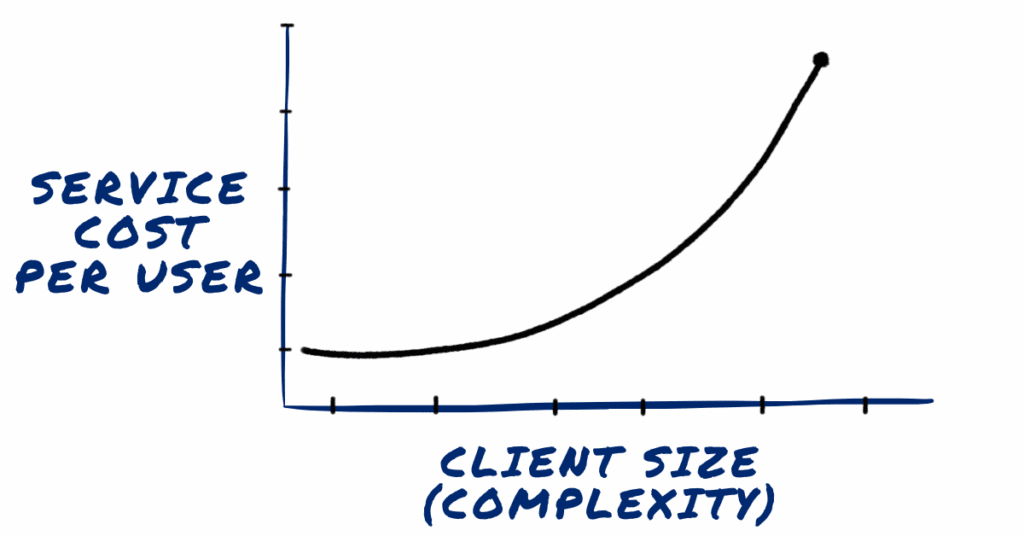
Volume discounts feel intuitive—more users, lower price per person—until you look at what larger accounts actually require. Moving to bigger customers increases complexity, not just headcount.
Bigger customers demand more skilled people, tighter oversight, heavier systems integration, formal review meetings, more rigorous compliance and documentation, and dedicated account management.
All of that raises your cost to deliver. Providers experienced in serving medium and large businesses therefore price larger accounts higher per user for a given service level—and they stick to complete service packages because partial offerings create delivery risk. That’s not greed; it’s the only way to fund the level of reliability those clients expect.
If your instinct is to lower the price per person as company size grows, you’re betting that scale reduces your cost per user. In practice, oversight requirements, managing multiple stakeholders, integration work, and talent costs rise with size—and the risk of losing a big client is higher and more painful than losing a small one. A pricing approach that gets cheaper as the account gets bigger often doesn’t fund the service properly, leading to delayed projects, stretched coverage, and stressed teams.
The experienced pattern is the opposite: publish a robust per-user price that increases with account complexity, and design your service to capture the true cost of enterprise-grade delivery.
“Let’s Just Match What Others Charge” (Please Don’t.)
Copying “market rates” sounds safe until you define the market: a mix of providers, many operating poorly, who don’t know their true costs and compete mainly on price.
Matching them means matching dysfunction. A better progression is to move from market-based pricing (immature and dangerous) to cost-based pricing (know your costs and aim for a healthy profit margin), and ultimately to value-based pricing (price relative to the business outcomes you improve). That progression is what sustainable providers follow as they mature their services.
To execute cost-based pricing credibly, you must calculate your costs of delivering service accurately. Less mature firms underestimate labor and tool costs, misallocate expenses, and hide profit gaps behind blended rates.
More mature firms allocate all direct labor costs—wages, benefits, taxes—to their managed services cost calculation, capture tool and facility costs, and compute realized profit percentage by client based on actual time tracking. This isn’t bureaucracy. It’s how you avoid accidentally underpricing and fund lasting quality.
Even more plainly: as you develop your systems and operations, your understanding of your true delivery cost rises—often to roughly double the initial estimate by the time the service offering reaches real competence.
Quality increases with that maturity, so pricing must too.
Providers who cling to “market rates” while their internal costs normalize at higher levels are walking themselves toward thin margins and staff burnout.
How to Structure Increases So They Land Well
The healthiest price increases aren’t improvisations—they’re policy.
Best-in-class firms raise prices annually, for all customers, at a modest, published rate tied to costs.
Exceptions exist, but they’re rare (roughly 5% or less of total revenue, 10% or less of any single service’s revenue). That universality prevents internal “special cases” from undermining the program and trains customers to expect and accept routine adjustments.
Communication matters. Explain that you invest in experienced engineers, around-the-clock tools, security and compliance upgrades, and proactive oversight that keeps systems healthy and problems rare.
Emphasize that the increase protects service levels and predictability—the outcomes executives care about. Most importantly, tie the change to your standardized service design so clients see you as a reliable operator, not a price opportunist.
Avoid itemized lists that invite line-by-line price shopping and undercut the integrity of your complete service model. How you package your pricing, not just the rate itself, influences how well customers understand and value your service.
When Customers Push Back
Even with thoughtful communication, someone will object.
Your job isn’t to give in immediately; it’s to understand the real issue.
If the objection is financial hardship, propose changes to what you deliver or the timeline that preserve reliability and security first. If it’s “competitors are cheaper,” explain your model: you price to deliver strong outcomes, not to imitate providers who don’t know or properly fund their true costs.
If it’s “we’re bigger so we should pay less per person,” walk through the oversight and integration costs that scale with size. Review meetings, account management, compliance workload—and how underpricing those elements jeopardizes the very reliability they value.
Guard your profit margin in the moment.
A “small” discount has a big effect on your profit percentage. For instance, a 10% price cut on a deal designed at 40% profit margin can give up roughly a quarter of your profit. That’s a lot of oxygen removed from the system that funds talent and tools.
Decline discounts by default; if you must accommodate, adjust what you deliver rather than the rate.
The Economics Under the Hood: Why Price Discipline Lifts Quality
Profit margins aren’t trophies, they’re the fuel for service quality.
Growing profit paired with expense discipline creates the steady earnings that let you staff adequately, invest in technology platforms, and retain good people—all of which customers feel as faster response, fewer escalations, and calmer projects.
If profit dollars slip while expenses rise, overall earnings compress even when revenue looks fine. You cannot “save” your way to excellence for long. The reliable path is systematic pricing health plus cost control, not sporadic heroics.
To support that path, treat your time and tools as real costs and forecast realistically.
Model recurring revenue and profit dollars, not just bookings. Include the recurring oversight work like preparing and conducting review meetings, because if you don’t price these activities, you’ll either skip them thus weakening strategy, or run them for free, leading training executives to undervalue them.
Build the five-year view for a new client: launch costs, stabilization and standardization projects, and typical additional projects so that revenue and costs accrue predictably. This is how you prevent “surprise” profit gaps later.
You’ll also want a clear pricing approach that’s resilient to changes coming in AI, cloud computing and device proliferation.
For cloud-heavy environments, adjust how you frame pricing units and fees so that profit isn’t eroded when servers disappear or vendors change.
Protect per-user economics as devices and third-party services multiply—otherwise your labor and management overhead rise without revenue keeping pace.
How to Present, Not Apologize
The best providers don’t bury price moves in fine print or spring them at renewal time. They make pricing predictable and visible.
They present a per-user price (or another finance-friendly unit) that encapsulates the complete service, resist itemized lists, and align packaging with how customers plan budgets.
They keep the increase schedule annual and universal. They train salespeople to discuss value—reliability, security posture, executive visibility rather than line items. And they give their delivery team a budget that actually funds the service standard. That combination calms customers and staff alike.
For larger accounts, they also explain calmly and specifically why enterprise-grade delivery costs more per user: more skilled personnel, more sophisticated tools and integration, oversight requirements, and higher risk if the relationship ends.
They show how underpricing those realities would jeopardize response times and project completion, then point to the mature industry pattern: complete managed services, priced for the real work.
What Changes Inside Your Company When You Get This Right
A funny thing happens when you stop pricing by fear and start pricing by realistic calculation: your culture steadies. Sales learns to attract and qualify customers who value outcomes—not discounts.
The Service Team runs a plan that matches the funded scope. Finance forecasts profit and expenses with confidence. And the whole organization rediscovers that raising prices isn’t about taking advantage of people; it’s about maintaining the financial health that keeps promises to customers and keeps evenings and weekends for your team.
Put bluntly, healthy profit margins fund team morale.
When your price supports the service, engineers aren’t asked to make up the gap with late-night heroics.
You staff appropriately, train adequately, and run fewer emergencies. That’s what your customers are buying—a partner who is still strong, responsive, and proactive next quarter and next year, not just this week.
A Practical Playbook You Can Start This Quarter
Begin by calculating your true managed services costs.
Allocate every direct labor dollar and tool and facility cost to the practice, and compute client-level realized profit margin using actual time tracking.
Then propose a price that doubles your fully loaded cost (or more), testing it with sensitivity checks on how busy your team is, wage levels, and realized billing rates. You’ll be surprised how quickly thin profit margins turn into a healthy range when you stop guessing.
Publish an annual price increase policy that applies to all accounts, with narrow, controlled exceptions—and track that exceptions remain within your limits. Put the schedule in your service agreements and renewal letters so no one is surprised.
Train salespeople to anchor the explanation in outcomes and to offer scope or timeline alternatives when a customer truly cannot afford the increase in the moment.
Avoid rate discounts; if you must accommodate, change what you deliver or the timing. Protect the engine.
For larger customers, align price with complexity. Don’t be afraid of a higher per-user rate; walk through the real costs and expectations of enterprise delivery. If a prospect still insists on a commodity-level price, it’s a fit signal—say “not yet” and move on.
A handful of healthy, well-funded relationships beats a dozen mispriced headaches every time.
Finally, remember that your first six to ten installations of any new service offering are for learning. Use them to surface true costs, refine what makes you different, and calibrate how you qualify prospects. Then make the lessons systematic—raise to sustainable pricing, simplify packaging, and keep improving delivery. That’s how the “unfair advantage” emerges: the compounding of small improvements into a system competitors can’t copy by undercutting your price.